9 Best Threshold Ramps for Sliding Doors (November 2026)
The best sliding door threshold ramps include the VEVOR 4" Rise Rubber Threshold Ramp for a tall, broad approach, the VEVOR Rubber Threshold Ramp for a low track and cut-to-fit width, and the Heonay Threshold Ramps for Doorways Self-Adhesive Rubber for a narrow low-profile strip.
On this page (7 sections)
- Which sliding door threshold ramp style fits your track?
- How we compared ramps for sliding doors
- Best threshold ramps for sliding doors
- How do you keep a ramp clear of the sliding panel?
- How do you choose between a bridge and a rubber wedge?
- What should wheelchair users check before crossing a sliding door ramp?
- Which sliding door threshold ramp should you choose?
The best sliding door threshold ramp for track clearance is a bridge-style ramp, such as the Ruedamann 1.6'' Rise Bridge Threshold Ramp. Its removable supports and bridge shape are designed for raised tracks, but you still need to confirm the ramp fits your doorway and the panel slides freely.
A sliding door has a narrow track, a moving panel and often a drainage path along the sill. A standard rubber wedge may smooth the approach, but it can also cover the track or sit where the door needs to move.
We compared the stated rise, dimensions, material and design of these options for sliding door use. Start with the doorway measurements, then choose a ramp shape that preserves the door's movement.
Our picks at a glance
-
1
 Best for a tall, broad approach
VEVOR 4" Rise Rubber Threshold Ramp
9.7/10 our score
See it on Amazon -
2

-
3
 Best for a narrow low-profile strip
Heonay Threshold Ramps for Doorways Self-Adhesive Rubber
9.2/10 our score
See it on Amazon
- 4
 Check it
GANSNAY 2" Rise Threshold Ramp for Doorways
Best for a 2 in rubber transition - 5
 Check it
Ruedamann 1.6'' Rise Bridge Threshold Ramp
Best for crossing a sliding door track - 6
 Check it
Ruedamann 1.5" Rise Wider 2200 Lbs Threshold
Best for a wide low rubber ramp - 7
 Check it
Nuvium Adjustable Threshold Ramp for Doorways
Best for a taller adjustable approach - 8
 Check it
DWALE Door Threshold Ramp 3" Rise Door
Best for a 3 in aluminum rise - 9
 Check it
Greymond Door Threshold Ramp for Doorways
Best for a small 1 in rise
Which sliding door threshold ramp style fits your track?
A bridge-style ramp is the most direct fit for a raised sliding door track because it can span the track instead of filling it. Rubber wedges work when the rise is low and the ramp can sit fully outside the panel's travel.
Before choosing, measure the sill from the floor to its top, the track width and the clear opening. Also check where the door panel, frame and drainage openings sit when the panel is fully open and fully closed.
If the threshold is just a small lip, a narrow strip may be enough. Our best rubber threshold ramp guide covers low rubber options, while our best bridge ramp for threshold guide focuses on bridge-style designs.
How we compared ramps for sliding doors
The best sliding door threshold ramp needs to address both the height change and the door's moving parts. We gave the strongest fit to bridge-style options and considered rubber ramps for lower transitions where a wedge can stay clear of the panel.
We checked the stated dimensions, rise, support or adhesive style, material and load capacity. These details help narrow a fit, but they cannot confirm your exact doorway, flooring or door clearance.
Our score weighs stated specs and features against the needs of a sliding door threshold.
| Product | Best for | Rise | Dimensions | Material | Our score |
|---|---|---|---|---|---|
| VEVOR 4" Rise Rubber Threshold Ramp | a tall, broad approach | 4 in | 41.8 x 24 in | Rubber | 9.7 |
| VEVOR Rubber Threshold Ramp | a low track and cut-to-fit width | 1.6 in | 35.4 x 7.9 in | Rubber | 9.6 |
| Heonay Threshold Ramps for Doorways Self-Adhesive Rubber | a narrow low-profile strip | 39.4 x 2 in | Rubber | 9.2 | |
| GANSNAY 2" Rise Threshold Ramp for Doorways | a 2 in rubber transition | 2 in | 31.5 x 8.7 in | Rubber | 9.1 |
| Ruedamann 1.6'' Rise Bridge Threshold Ramp | crossing a sliding door track | 1.6 in stated height | 16 x 28 in | Aluminum | 9.0 |
| Ruedamann 1.5" Rise Wider 2200 Lbs Threshold | a wide low rubber ramp | 1.5 in | Rubber | 8.9 | |
| Nuvium Adjustable Threshold Ramp for Doorways | a taller adjustable approach | 36 x 22 in | Aluminum | 8.7 | |
| DWALE Door Threshold Ramp 3" Rise Door | a 3 in aluminum rise | 3 in stated rise | 34 x 17 in | Aluminum | 8.5 |
| Greymond Door Threshold Ramp for Doorways | a small 1 in rise | 1 in | 35.5 x 5.3 in | Rubber | 8.2 |
Best threshold ramps for sliding doors
The Ruedamann bridge ramp is the clearest track-specific pick, while the rubber options suit low sills that leave the door's path open. Choose by fit first, then compare portability, width and installation style.
VEVOR 4" Rise Rubber Threshold Ramp: Best for a tall, broad approach
- 4 in rise
- 41.8 x 24 in dimensions
- Three cable channels
- 65 lb
Its broad, one-piece rubber surface suits a tall transition where the full ramp can sit outside the sliding door's path. The stated 14 degree slope requires another person's assistance for wheelchair use.
Pros
- Broad 24 in surface
- Three channels for cords or hoses
- No-tool setup
Cons
- 65 lb weight makes moving it harder
- Maker says wheelchair use needs assistance because of the steep slope
The VEVOR 4-inch ramp has a 41.8 x 24 in rubber surface and weighs 65 lb. That broad, heavy one-piece design may suit a tall outside approach, but it needs substantial clear floor space around a sliding door.
The surface has a raised button texture and three channels for wires, cables or hoses. Its 4 in rise is much taller than a typical low track, so measure the actual height change rather than assuming the track needs a full entry ramp.
VEVOR describes the slope as about 14 degrees and says wheelchair use is only suitable with another person's assistance. That makes this a poor match for independent wheelchair use.
Consider it only when the transition is genuinely tall, the ramp can sit clear of the moving panel and help is available for wheelchair passage. For a removable setup, see our guide to removable wheelchair ramps.
VEVOR Rubber Threshold Ramp: Best for a low track and cut-to-fit width
- 1.6 in rise
- 35.4 in long
- Cuttable width
- Double-sided tape included
This low rubber ramp can be cut to fit a doorway width and fixed to smooth flooring with included tape. Its triangular profile may cover a track area, so confirm the door still travels freely.
Pros
- Cuttable to fit width
- Anti-slip stripes
- Tape included for smooth floors
Cons
- Solid ramp may sit in the door's travel path
- Confirm track and sill measurements before cutting
The VEVOR Rubber Threshold Ramp has a 1.6 in rise and measures 35.4 x 7.9 in. It can be cut to fit a doorway width, and double-sided tape is included for smooth floors.
Its solid rubber wedge works better for a low sill than a tall step. For more options suited to inside use, see indoor wheelchair ramps.
Since it is not a bridge, place it only where it does not block the track, panel or water drainage.
VEVOR describes anti-slip stripes on the surface. Measure before cutting, because trimming the width cannot solve a mismatch in rise or a ramp that sits in the door's path.
This is a practical option when you need a low fixed transition and can confirm the panel still moves. For a different broad entrance, compare our best garage door threshold ramp guide.
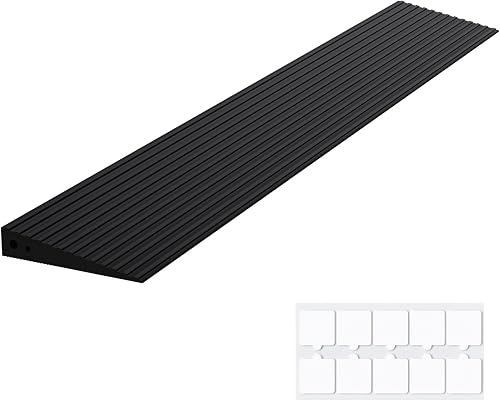
Heonay Threshold Ramps for Doorways Self-Adhesive Rubber: Best for a narrow low-profile strip
- 0.4 in high
- 2 in wide
- Self-adhesive backing
- Cuttable length
The narrow strip can address a small lip while taking less floor space than a full wedge. Its 0.4 in height is only suitable when that small rise matches the track transition.
Pros
- Narrow 2 in profile
- Self-adhesive backing
- Can be cut to length
Cons
- Only 0.4 in high
- Adhesive placement needs a clear, clean surface
The Heonay strip is just 2 in wide and 0.4 in high, making it the lowest-profile option in this group. It is self-adhesive and can be cut to length.
That narrow shape can address a small raised lip without placing a full wedge across the floor. It will not bridge a deep track or replace a ramp with a longer slope.
Check that the strip does not stick to the moving door panel and that the adhesive surface is clean and suitable. Its 0.4 in height also needs to match the height change you measured.
Choose it for a small fixed transition where the track geometry allows a slim strip. If you are comparing ramp shapes, [What Are the Types of Wheelchair Ramps?
What’s Involved](/what-are-the-types-of-wheelchair-ramps/) explains common designs and tradeoffs.
GANSNAY 2" Rise Threshold Ramp for Doorways: Best for a 2 in rubber transition
- 2 in rise
- 31.5 x 8.7 in
- 4.4 lb
- Grooved surface
A 2 in rise and 8.7 in width offer a compact rubber option for a fixed sill. Check that the wedge stays clear of the sliding panel and any drainage openings.
Pros
- Light 4.4 lb weight
- Grooved surface
- Can be cut with a saw
Cons
- Wedge shape may obstruct the moving panel
- Confirm fit before trimming
The GANSNAY ramp has a 2 in rise and measures 31.5 x 8.7 in. Its grooved rubber surface and 4.4 lb weight make it easier to position than the heavier one-piece ramps.
The maker says it needs no screws or tape and can be cut with a saw. As a wedge, it still needs floor space and may cover the track if placed too close to the sill.
Check how far the panel extends over the threshold when closed. Keep the ramp outside that route and avoid covering drainage openings.
Pick it when a 2 in rise matches the doorway and a rubber wedge can sit clear of the panel. If your measured rise is close to 1.6 in, compare the lower VEVOR option above.
Ruedamann 1.6'' Rise Bridge Threshold Ramp: Best for crossing a sliding door track
- Bridge-style design
- Removable supports
- 16 in long
- 600 lb capacity
The bridge-style surface is designed to span raised thresholds and sliding door tracks, and removable supports adapt to different threshold heights. Measure the track, doorway width and panel clearance to confirm the bridge fits.
Pros
- Bridge-style track coverage
- Removable supports
- No installation needed
Cons
- Supports up to 600 lb
- Check actual track width and door clearance
The Ruedamann bridge ramp is the best match for a sliding door track among these picks. Its bridge-style design is described for raised tracks and patio doors, and removable supports adapt to different threshold heights.
The ramp measures 16 x 28 in and is made from aluminum, with a stated capacity of 600 lb. Its setup is portable and does not require installation, so you can move it when the doorway needs to remain clear.
Measure the track and ramp support spacing before choosing it. The product dimensions and support fit need to work with your sill, and the bridge must not obstruct the door panel's travel.
Choose this style if the track is raised and you need a surface that spans it. See our best aluminum threshold ramp guide for more aluminum options.
Ruedamann 1.5" Rise Wider 2200 Lbs Threshold: Best for a wide low rubber ramp
- 1.5 in rise
- 43.3 in wide
- Cuttable
- 2200 lb capacity
Its 43.3 in width covers a broad entry, and the rubber ramp can be trimmed to fit. As a solid wedge, it needs a placement check so it does not block the sliding panel or drainage.
Pros
- Wide 43.3 in surface
- Can be trimmed
- 2200 lb stated capacity
Cons
- 7.5 in depth may take floor space
- Not a bridge over the track
The Ruedamann rubber ramp is 43.3 in wide with a 1.5 in rise, giving it a broad surface for a low transition. It can be trimmed and has a stated 2200 lb capacity.
Its 7.5 in depth means it occupies floor space near the doorway. Because it is a solid wedge rather than a bridge, check the panel's full travel and keep the track's drainage area open.
The rubber construction may suit indoor or outdoor placement, according to the maker. Confirm the surface beneath it is level and that the ramp does not shift when approached.
Choose this when a broad rubber ramp fits the sill and the door remains unobstructed. A low-rise wedge may also appear in a best threshold ramps for wheelchairs comparison.
Nuvium Adjustable Threshold Ramp for Doorways: Best for a taller adjustable approach
- Adjusts from 2.6 to 6 in
- 22 x 36 in surface
- 1100 lb capacity
- Swivel feet
Independent height adjustment and swivel feet can help position the ramp where a doorway has a taller transition. Its angled platform needs clear floor space and careful placement near the door.
Pros
- Adjustable height
- Feet adjust independently
- Non-slip strips
Cons
- May intrude into the sliding panel's path
- Requires stable placement on a firm surface
The Nuvium ramp adjusts from 2.6 to 6 in with independent heightening screws and swivel feet. Its 22 x 36 in aluminum surface is intended for taller thresholds and small steps.
This is an angled platform, so it may need more floor space than a compact track bridge. Check its feet can rest on stable ground, and make sure the ramp does not reach into the sliding panel's path.
Frosted anti-slip strips sit on the surface, and rubber strips are under the ramp's ground contact areas. Measure both sides of an uneven threshold because the legs adjust separately.
Consider this option when the sill is taller and adjustable feet address a height difference. It is not the simplest choice for a low track that needs a compact bridge.
DWALE Door Threshold Ramp 3" Rise Door: Best for a 3 in aluminum rise
- 34 x 17 in
- 3 in stated rise
- Adjustable top flap
- 800 lb stated capacity
The aluminum ramp has an adjustable top flap and sections that connect without tools. Its 17 in width calls for a careful check around the sliding panel, frame and walkway.
Pros
- Adjustable top flap
- Sections connect without tools
- Portable for storage
Cons
- Actual height is stated as 3.3 in
- Wide angled surface may interfere with door movement
The DWALE aluminum ramp has a 34 x 17 in surface and an adjustable top flap. It connects without tools and is described for wheelchairs, scooters, walkers and other wheeled equipment.
The stated rise is 3 in, while the dimensions note an actual height of 3.3 in. Check the real transition height and the flap position against your own threshold before deciding.
Its 17 in width can occupy much of the floor beside a sliding door. Use it only if the panel, frame and walkway all have clear space.
This is a portable option for a taller entry where the flap helps meet the sill. It is not a bridge-style design for a narrow track.
Greymond Door Threshold Ramp for Doorways: Best for a small 1 in rise
- 1 in rise
- 35.5 x 5.3 in
- Adhesive pads included
- Cuttable
This 1 in rubber ramp is cuttable and includes adhesive pads for smooth flooring. Its shallow profile may suit a small lip, but it is not shaped to bridge an open track.
Pros
- Low 1 in rise
- Adhesive pads included
- Can be cut to width
Cons
- Not a bridge-style ramp
- Confirm adhesive placement and panel clearance
The Greymond ramp has a 1 in rise and a 35.5 x 5.3 in rubber surface. The ramp can be cut to width, and adhesive pads are included for smooth floors.
Its low height may fit a small sill where the full track does not need to be spanned. The ramp is still a wedge, so keep it clear of the moving door and any drainage route.
The textured surface has grooves, and the underside has a non-slip pattern. Confirm the ramp rests evenly and that the adhesive pads suit the floor finish.
Choose it for a low transition with enough floor space for the ramp. For a mobility setup that includes transfers near the doorway, see Transfer Board vs Slide Board: Is There a Difference?.
How do you keep a ramp clear of the sliding panel?
Leave the door's full travel path open, including the space the panel occupies when closed. A ramp that seems clear with the door open may still stop the panel from closing or latch engagement.
Measure the gap under the door panel, track width and frame projection. If a ramp sits near the sill, move the panel slowly through its full travel and check for contact before relying on it.
Keep drainage openings clear. Water trapped at a sliding door can collect at the sill, so avoid covering channels or gaps that carry water away.
How do you choose between a bridge and a rubber wedge?
Choose a bridge when the track itself must be crossed and the design can rest securely on both sides. Choose a rubber wedge when the rise is low and you have room to place it outside the panel's path.
For a bridge, check the support locations, clear opening and track width. For a wedge, check the rise, depth and whether it can sit flush without covering drainage.
A bridge can be moved when the doorway needs space, while rubber ramps may use adhesive or simply rest on the floor. Follow the ramp's setup instructions and inspect for movement before each use.
What should wheelchair users check before crossing a sliding door ramp?
Check the ramp's rise, approach space, surface traction and stability, then confirm the wheelchair can cross it safely with the intended level of assistance. A steep or narrow ramp can be unsuitable even when its stated capacity is high.
VEVOR says its 4 in ramp has a slope of about 14 degrees and is only suitable for wheelchair use with another person's assistance. Ask an occupational therapist or qualified access professional if you need help assessing a specific chair and doorway.
Keep the entry free of loose mats, cords and water. For a broader comparison of materials and profiles, read our best threshold ramps for wheelchairs.
Which sliding door threshold ramp should you choose?
Choose the Ruedamann bridge ramp when you need to cross a raised track while preserving door movement, after checking the support fit and panel clearance. Choose a rubber ramp such as the low VEVOR or Greymond when the rise is modest and the wedge can stay outside the door's travel.
Measure first, then choose the profile that matches the sill. A ramp that fits the rise but blocks the panel or drainage is the wrong fit for a sliding door.
Our top 3 picks at a glance
-
1
Best for a tall, broad approach
VEVOR 4" Rise Rubber Threshold Ramp
9.7/10 our score
See it on Amazon -
2
-
3
Best for a narrow low-profile strip
Heonay Threshold Ramps for Doorways Self-Adhesive Rubber
9.2/10 our score
See it on Amazon
Frequently asked questions
What type of ramp works best over a sliding door track?
A bridge-style ramp is usually the best starting point when you need to span a raised sliding door track. It can sit over the track rather than filling the track with a solid wedge.
Measure the track width, rise and doorway opening, then confirm the door panel can still slide and the ramp supports can sit securely.
Can a rubber threshold ramp go in front of a sliding door?
Yes, if the rubber ramp clears the moving panel, track and drainage path. A wedge can help with a low sill, but it may occupy space where the door panel or its frame needs to move.
Check the door through its full travel before using the ramp.
How do I measure for a sliding door threshold ramp?
Measure the height difference, the track width, the clear doorway width and the floor space on each side. Also measure how far the sliding panel travels and where the door's drainage openings sit.
Compare those measurements with the ramp's support positions and surface dimensions before buying.
Can I leave a threshold ramp under a sliding door?
Only if the door panel moves freely above it and the ramp does not block the track or drainage. Test the full door movement after positioning the ramp, and check that it stays stable during use.
A removable ramp is easier to move when the door needs clear access.
Should I choose a rubber or aluminum ramp for a sliding door?
Choose by the shape of the transition. A rubber wedge can suit a low rise and broad floor contact, while an aluminum bridge can span a track and use supports to sit over it.
For more options, compare our best threshold ramps for wheelchairs.


